
Planning a trip to Bali in 2026 is an exhilarating prospect, but as the island continues to evolve into a global tourism powerhouse, the logistics of getting from point A to point B have become increasingly complex. With massive new infrastructure projects to handle the booming popularity, changing local regulations regarding tourist driving, and the sheer volume of international travelers arriving daily, your choice of Bali transport is no longer just a minor detail—it is the very foundation of your entire holiday experience. Get this right, and you'll experience the magic of the Island of the Gods seamlessly. Get it wrong, and you might spend precious vacation hours stuck in gridlock sweating in the tropical heat.
In this exhaustive, highly-detailed master guide, we will break down absolutely every possible way to navigate the island in 2026. From the moment you land at Ngurah Rai International Airport to the evening you navigate back from a jaw-dropping Uluwatu sunset, we are providing you with the exact insider knowledge needed to save time, optimize your money, prevent stress, and travel like an absolute pro. This is your definitive blueprint to mastering Bali transport.
1. The Current State of Bali Traffic and Infrastructure in 2026
Before diving deeply into the specific vehicle options and booking methods, it is incredibly crucial to understand the current landscape of the island. In 2026, Bali has seen a significant, almost unprecedented shift in daily traffic patterns. Areas that used to be quiet, sleepy surf villages—like Canggu, Pererenan, Uluwatu, and even the northern ridges of Ubud—are now bustling hubs of international activity, luxury villas, and high-end beach clubs.
While the local and national governments have introduced several new road widening initiatives and traffic management deployments to handle the influx, the core layout of the island relies heavily on historical, ancient roads. Furthermore, the "traditional zones" (wilayah adat) managed directly by powerful local village communities remain a vital, legally enforced part of the island's fabric.
What does this mean for you, the traveler? It means that relying rigidly on a single mode of travel (like stubbornly trying to use an app for every single trip) might not be enough anymore. To truly conquer Bali transport in 2026, you need a multi-faceted strategy that combines high reliability, extreme comfort, and deep local expertise to bypass bottlenecks effectively.
2. Private Car Charter: The Ultimate Choice for Comfort, Safety, and Total Flexibility
For the vast majority of international visitors—whether you are a family with small children, a group of friends chasing waterfalls, or a couple on a romantic honeymoon—hiring a private car with a dedicated driver is, without question, the absolute gold standard of Bali transport. It offers a level of sanctuary, privacy, and convenience that is completely indispensable in the humid tropical heat.
Here is exactly why Private Charters dominate in 2026:
- The "Jalan Tikus" (Secret Rat Run) Advantage: Local, experienced drivers possess an innate, almost instinctual knowledge of Bali’s narrow, unmapped backroads (locally known affectionately as jalan tikus). When a massive main artery like Sunset Road in Seminyak or Raya Ubud is completely blocked due to an intricate (and beautiful) religious ceremony, a fallen massive banyan tree, or a sudden afternoon monsoon downpour, a professional driver can instantly reroute and navigate around the gridlock, saving you hours of frustration.
- Unbeatable Cost-Effectiveness for Groups: When you mathematically break down the flat rate cost of a comprehensive full-day charter (typically lasting 10 to 12 hours) and divide it among 4 to 6 passengers, it almost always proves significantly more affordable than taking multiple individual, metered taxis or dealing with extreme ride-hailing surge pricing during peak hours.
- 100% Customizable, Zero-Stress Itineraries: Unlike a rigid, heavily commercialized 40-person tour bus that operates on a strict timetable, a private Bali transport service allows you to dictate every single moment of the pace. Want to spontaneously spend an extra two hours meditating at the Tirta Empul water temple? See a random local market you want to stop at? Your dedicated driver will be waiting patiently, guarding your belongings, with the air-conditioning running for your return.
- Asset Protection: When you are out hiking down a cliff to reach a hidden beach, having a secure, locked private car with an assigned driver watching over your expensive cameras, shopping bags, and passports gives you incredible peace of mind.
3. Comparing Bali Transport Options: A Detailed Side-by-Side Analysis
To help you make the absolute best decision for your specific itinerary, let’s look critically at the most common methods used by tourists navigating the island in 2026. Understanding the pros and cons of these Bali transport methods will save you from major headaches.
A. Professional Private Hire (Cars & Minivans)
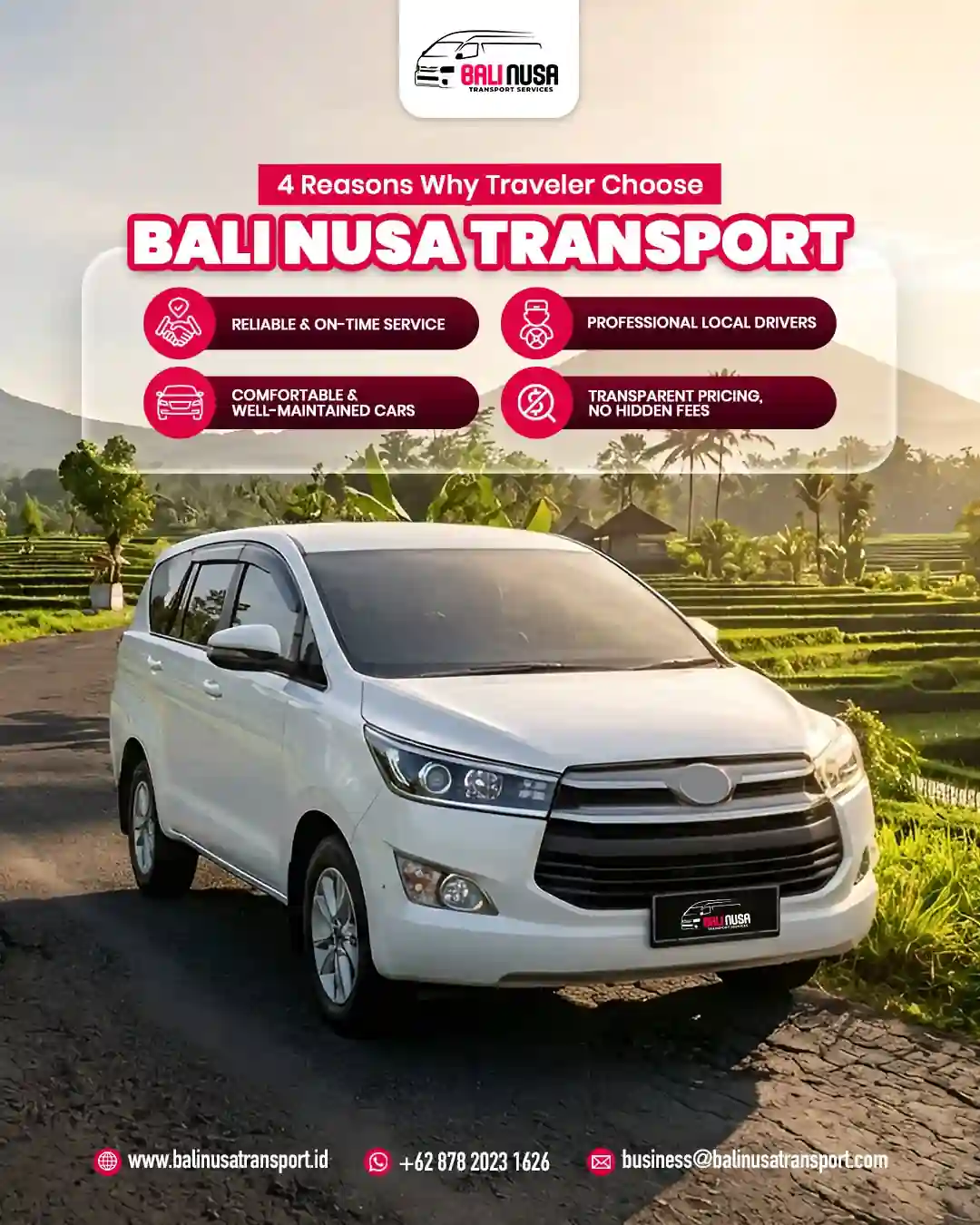
As mentioned, this forms the highly reliable backbone of the Bali transport industry. You are provided with a modern, impeccably clean, deeply air-conditioned vehicle (the standard is usually a sleek Toyota Avanza or Toyota Innova, while larger groups use the Toyota Hiace Commuter) and a highly vetted driver who organically doubles as a friendly local guide and translator.
- Best For: Comprehensive day tours exploring multiple regions, families needing child seats, travelers moving between distant luxury villas with a lot of heavy luggage, and anyone wanting a zero-stress vacation.
- Major Benefit: You never have to worry about finding parking at crowded tourist hotspots—you get dropped off right at the front gate.
B. Scooter and Motorbike Rentals
Rentals are instantly recognizable, iconic, and photograph well, but they are increasingly risky. Renting a 125cc scooter or an NMAX is technically the cheapest physical way to get around. However, in 2026, the local police authorities and the provincial government have, rightfully so, become incredibly strict. Checkpoints are common to verify valid international driving permits (specifically endorsed for motorcycles) and the mandatory use of safety helmets.
- Best For: Highly experienced, properly licensed solo travelers or couples who are staying strictly within a very small, defined radius (e.g., just hopping between cafes in Bingin, or driving down the single road in Amed).
- Major Warning: If you are not an experienced rider in your home country, Bali is emphatically not the place to learn. Without a valid International Driving Permit, major travel insurance policies will absolutely void your coverage in the event of any accident.
C. Local Ride-Hailing Apps (Grab & Gojek)
These heavily utilized apps are absolutely fantastic for ordering local food delivery (like Nasi Goreng straight to your villa) and for taking very short, spontaneous hops around highly developed urban zones. However, they face extreme logistical challenges in 2026 primarily due to the enforcement of "Traditional Transport Zones" (Zona Transportasi Lokal).
- Best For: Very short, quick point-to-point urban trips strictly within the south (like going 2 kilometers down the road in Seminyak or Legian when you don't feel like walking).
- Major Limitation: In hyper-popular areas like the center of Ubud, the cliffs of Pecatu (Uluwatu), and the temple grounds of Tanah Lot, local authorities and communities strictly forbid app-based drivers from picking up passengers. While they can drop you off, you will find yourself stranded when trying to order a car to leave, forcing you to negotiate at steep premiums with local unmetered drivers.
4. Master Your Arrival: Nailing the Bali Airport Transfer
The success of your entire holiday literally begins the moment you step out of the baggage claim at Ngurah Rai International Airport (DPS) in Tuban. The arrival hall is legendary—it is a concentrated wall of sound, heat, and dozens of eager, unofficial drivers actively soliciting your business. Far too many first-time tourists make the critical mistake of arriving completely without a plan, assuming it will be "easy" to just figure it out on the fly.
Opting for a carefully pre-booked, reliable Bali Airport Transfer is single-handedly the most efficient, vital sub-sector of planning your Bali transport. By organizing this in advance, you ensure that as soon as you clear customs and step out the glass doors, you are immediately greeted by a professional holding a personalized sign with your name. They will assist with your heavy bags, escort you away from the chaotic crowds, and lead you straight to a pre-cooled, spacious vehicle. Furthermore, you lock in a fixed, highly transparent rate, completely eliminating the exhausting need to haggle over prices after a gruelling 14-hour international flight.
5. Regional Logistics: A Micro-Guide on How to Navigate Each Major Area
South Bali (Seminyak, Kuta, Legian, Sanur)
This region represents the oldest, most heavily developed tourist infrastructure on the island. Traffic on the main arteries (like Sunset Road and the Ngurah Rai Bypass) is incredibly heavy, but the roads themselves are generally wider and better paved. In this zone, a hybrid strategy works wonders: rely on walking or short-distance metered taxis/apps for your local dinner trips, but strictly utilize private hire for longer excursions out of the zone.
The Canggu-Pererenan-Seseh Corridor
Let's be honest: traffic here is internationally notorious in 2026. The infrastructure was built for small farming communities, not thousands of daily international visitors. If you are specifically using Bali transport to move between massive beach clubs like Finns or Atlas, you must aggressively plan for extra travel time. The famous "Shortcuts" (Jalan Pintas) that cut through the rice paddies are famous for being incredibly narrow—often causing standstills. Having a highly experienced driver who knows exactly when to avoid these shortcuts is absolutely vital to your sanity here.
The Bukit Peninsula (Uluwatu, Bingin, Pandawa, Ungasan)
The dramatic, breathtaking roads here are distinctly different—they are hilly, winding, and often lack streetlights. Motorbikes and scooters are immensely popular here for the surf crowd navigating the tight pathways down to the cliff breaks. However, if your itinerary includes visiting major cultural sites, like heading to the Uluwatu Temple for the evening Kecak Fire Dance, booking a private car for the evening is highly, highly recommended. Finding a stray taxi to take you back to your hotel in the pitch black after the dance ends with thousands of other tourists exiting simultaneously is a logistical nightmare you want to avoid.
Central & North Bali (Ubud, Kintamani, Bedugul, Lovina)
Ubud serves as the phenomenal cultural heart of the island but is also a severe traffic bottleneck due to its one-way street system. Once you are securely in the very center of town, consider it a strictly walking town. However, the true magic of this region lies outside the town center—exploring the vast, sweeping Tegalalang rice terraces, chasing the thundering waterfalls of Sekumpul, or driving up to the cool volcanic ridges of Kintamani. To achieve this, booking a structured, full-day Bali transport charter with a confident driver familiar with steep mountain inclines is the only safe and practical way to go.
6. Deep Dive: Understanding Exact Costs and Budgeting for 2026
Accurately budgeting for your travel and specifically your Bali transport is crucial for a stress-free holiday. In 2026, general transportation prices have stabilized post-pandemic, but inflation means it is more important than ever to know exactly what is included in your quote. Never just agree to a low base number without asking the right questions.
| Service Type & Duration | Typical 2026 Standard Rate (IDR) | Exactly What's Included? |
|---|---|---|
| Half-Day Private Charter (Up to 6 Hours) | IDR 500,000 - 600,000 | Dedicated English-speaking driver, unlimited patrol/fuel within zone, standard 6-seater vehicle. |
| Full-Day Private Charter (10 to 12 Hours) | IDR 650,000 - 850,000 | Dedicated English-speaking driver, full tank of patrol/fuel, standard 6-seater vehicle, driver's meals. |
| Premium Full-Day Charter (Innova Reborn / Alphard) | IDR 850,000 - 2,400,000 | Premium upgraded spacious vehicle, driver, all fuel, ideal for mountain climbs and sheer comfort. |
| Standard Airport Transfer (To Kuta/Seminyak/Nusa Dua) | IDR 225,000 - 275,000 | Terminal Meet & Greet with name sign, all airport parking fees handled, direct smooth transfer to hotel lobby. |
| Long Distance Transfer (Airport to Ubud/Uluwatu/Canggu) | IDR 300,000 - 475,000 | Terminal Meet & Greet, all airport parking fees, comfortable highway transfer avoiding local scams. |
Crucial Note: Always relentlessly clarify with your provider if standard parking fees at tourist sites and mandatory toll roads (such as the incredibly useful Bali Mandara Toll across the ocean) are fully included in your final quote to prevent awkward situations at toll booths.
7. Top Safety Tips and How to Avoid Common Transport Scams
While the island of Bali is generally a very safe, incredibly hospitable destination full of genuinely wonderful people, the bustling Bali transport industry is massive, and like any major global tourist hub, it unfortunately does have a few distinct pitfalls for the unwary traveler:
- The Infamous "No Meter / Broken Meter" Scam: If you are physically hailing a street taxi (specifically looking for the reputable Blue Bird group with their distinct blue cars and bird logo), absolutely always ensure the driver immediately turns on the physical meter when you enter. If they claim it is "broken" or they try to negotiate a wildly inflated flat fare, simply step out of the vehicle, close the door, and confidently find another.
- The "Sudden Road Closure / Temple Closed" Lie: This is a classic tactic used by some unvetted, unofficial drivers roaming the streets. They might tell you mid-journey that your chosen destination (like the Monkey Forest or a specific holy temple) is magically "closed today for a special ceremony." This is almost always a lie designed explicitly to pivot your itinerary and take you instead to a massive, overpriced silver or batik shop where that driver receives a lucrative 30% to 40% hidden commission on your purchases. By utilizing a thoroughly vetted, reputable company, you ensure you get completely honest, unbiased information focused purely on your experience.
- The Unlicensed Scooter Trap: If you do decide to rent a motorbike, physically inspect the vehicle thoroughly, take a video of existing scratches before carefully paying, and legally ensure you have the proper paperwork. Without a police-stamped International Driving Permit (IDP) specifically showing motorcycle endorsement, your expensive international travel insurance will almost certainly refuse to pay out tens of thousands of dollars in medical bills in the event of a crash. Be smart.
8. The Future: Sustainable Travel and Community Support
Looking into the remainder of 2026 and beyond, there is a massive, accelerating movement toward ethical, eco-friendly travel on the island. While electric vehicles (EVs) are slowly making their way into luxury fleets, the most immediate way you can practice sustainable tourism is by how and who you choose to spend your money with for your Bali transport needs.
By consciously choosing local, completely Balinese-owned and operated professional transport companies rather than massive multi-national conglomerates, you are making a direct, positive impact. You are ensuring that your hard-earned holiday money stays deeply within the Balinese community, directly supporting local village families, paying for local school tuitions, and fostering sustainable tourism initiatives that respect the island's fragile ecology and profound cultural heritage.
Conclusion: Why Supreme Reliability is Everything You Need
In the end, as you reflect on your dream vacation on the flight back home, your memories of Bali should be absolutely dominated by the breathtaking sight of a vivid orange sunrise cresting over the caldera of Mount Batur. It should be about the incredible, spicy taste of authentic, crispy Babi Guling in a local warung, and the soothing, rhythmic sound of the vast Indian Ocean crashing against the limestone cliffs of Uluwatu.
Your memories should categorically not be about the intense stress of a roadside vehicle breakdown in the midday heat, a tragically missed dinner connection at a high-end restaurant because of poor planning, or feeling ripped off by an unregulated street driver.
For all travelers who rightfully demand the absolute highest, uncompromising standards of reliability, profound vehicle comfort, unquestionable safety, and deep local insight, securing premium Bali transport services is the ultimate key. Whether you require a hyper-efficient, simple airport pickup, a complex multi-day island exploration, or a glamorous evening out, you need a flawless gateway to the island. Get the right driver, get the right vehicle, and go make 2026 your most unforgettable, spectacular Bali holiday yet.
Book Your Reliable Bali Transport Today!
Say goodbye to travel stress. Get a customized, transparent quote for your Bali trip today with professional English-speaking drivers.